
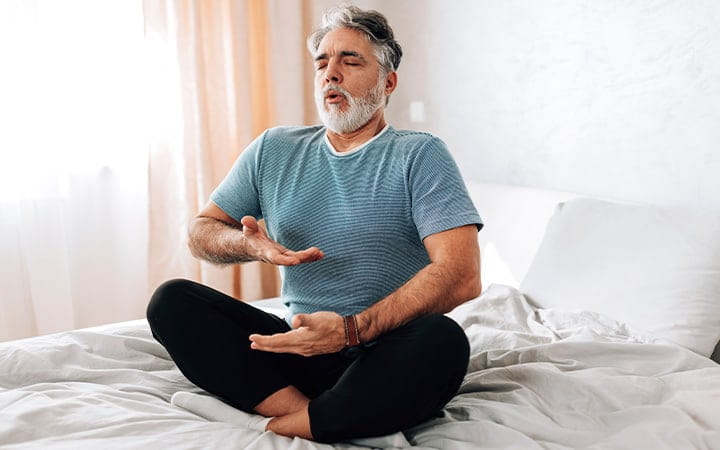
Stress can change the way you breathe. Breaths may become quick, shallow, or irregular, especially during conflict, heavy workloads, traffic, or uncertainty. This physical pattern can make the body feel even more alarmed.
Breathing exercises do not remove the cause of stress, but they can create a brief pause. They may help you slow down, notice physical tension, and respond more thoughtfully.
The exercises should feel gentle. Stop if you become dizzy, short of breath, or uncomfortable. People with breathing, heart, or other health conditions should seek professional guidance before trying more demanding techniques.
Extended Exhale Breathing
A longer exhale can feel calming for many people.
Sit comfortably and relax your shoulders. Inhale through your nose for a comfortable count, then exhale slightly more slowly.
For example, you might inhale for three counts and exhale for five.
Do not force the numbers. The breath should remain smooth.
Repeat for one or two minutes.
Use this exercise before answering a difficult message, entering a meeting, or beginning a demanding task.
Box Breathing
Box breathing uses equal stages.
Inhale for a comfortable count, pause, exhale for the same count, and pause again.
A count of three or four may work, but shorter counts are acceptable.
Avoid long breath holds if they feel uncomfortable.
Visualize tracing the four sides of a square as you move through each stage.
This technique can provide structure when thoughts feel scattered.
Belly Breathing
Stress often causes breathing to remain high in the chest.
Place one hand on your upper chest and the other on your abdomen.
Breathe gently and notice whether the lower hand moves.
Allow the abdomen to expand naturally during the inhale and soften during the exhale.
Do not push the stomach outward forcefully.
Practice while sitting or lying in a comfortable position.
Information about body awareness and physical function may help explain why posture and muscle tension can affect breathing comfort.
Counting Breaths
Counting gives the mind a neutral task.
Breathe normally and count each exhale from one to ten.
When you reach ten, begin again.
When your mind wanders, return to one without criticizing yourself.
The exercise does not require perfect concentration.
Use it for two to five minutes during a break.
This method can be useful when worries repeat because it redirects attention without demanding complete mental silence.
The Three-Breath Pause
This exercise is designed for busy moments.
Before reacting, take three slow and comfortable breaths.
On the first breath, notice what is happening in your body.
On the second, relax your jaw and shoulders.
On the third, decide what action is needed.
Three breaths will not solve every problem, but they may prevent an impulsive response.
Readers exploring simple stress-relief methods can use this pause throughout the day without needing a private room.
Pursed-Lip Breathing
Inhale gently through your nose.
Shape your lips as though you are blowing out a candle and exhale slowly.
Do not force the air.
This can help slow the breathing pace.
Pursed-lip breathing is sometimes used in specific medical contexts, so people with respiratory conditions should follow their professional treatment plan.
Do not use a breathing exercise as a replacement for urgent care when you experience severe breathlessness, chest pain, fainting, or blue lips.
Humming Exhale
Humming can lengthen the exhale and provide a steady vibration.
Inhale gently through your nose, then hum softly as you breathe out.
Keep the sound comfortable and quiet.
Repeat several times.
This technique may feel awkward in public, so use it at home, in a parked car, or another private place.
Stop if the vibration causes discomfort.
Breathing With a Word
Choose a simple word such as calm, steady, or release.
Think the first part of the word while inhaling and the second while exhaling.
Alternatively, silently say “I am here” during the breath.
The phrase gives the mind something supportive to follow.
Avoid using complicated statements that require concentration.
Balanced unfiltered discussions about daily wellbeing can remind people that effective techniques do not need to appear impressive.
Five-Finger Breathing
Hold one hand open.
Use a finger from the other hand to trace the outline.
Inhale as you trace up one finger and exhale as you trace down.
Continue across all five fingers.
The combination of touch, movement, and breathing can help redirect attention.
This method can be especially useful when sitting at a desk or waiting for an appointment.
Walking With the Breath
Walk at a comfortable pace.
Notice how many steps naturally fit within an inhale and an exhale.
Do not force the breath to match an exact pattern.
Allow the pace to slow when needed.
This method combines movement with present-moment attention.
Use it in a safe place away from traffic and obstacles.
Follow practical personal safety guidance when walking outdoors, especially at night or while feeling distracted.
Shoulder-Release Breathing
Inhale gently while lifting the shoulders toward the ears.
Exhale and let them drop.
Repeat several times without straining the neck.
This may help you notice how much tension has accumulated.
Move slowly and avoid the exercise if it worsens pain.
Persistent neck, shoulder, or back discomfort should be evaluated professionally.
Breathing Before Sleep
Lie down comfortably and allow the breath to settle.
Place attention on the exhale without changing it too quickly.
Gradually let the exhale become smoother.
Count backward from ten if the mind remains busy.
Avoid turning the exercise into a test.
The purpose is to rest, not to achieve a perfect breathing pattern.
Use Breathing With Other Strategies
Breathing works best as one part of stress management.
Combine it with regular movement, clear work boundaries, adequate meals, hydration, supportive conversation, and healthy sleep.
A breathing technique cannot fix an impossible workload or unsafe relationship.
Use the calmer moment to decide what practical action is needed.
That may include asking for help, postponing a task, leaving a stressful environment, or speaking with a professional.
Know When Symptoms Need Medical Attention
Stress can cause physical sensations, but serious symptoms should not be assumed to be anxiety.
Seek urgent medical care for severe breathing difficulty, chest pain, fainting, sudden weakness, confusion, or other alarming changes.
Speak with a healthcare professional if panic, anxiety, or breathing discomfort becomes frequent.
Breathing exercises are most useful when they remain simple, comfortable, and easy to repeat. Start with extended exhales, counting, or a three-breath pause. Practice during calm moments so the method feels familiar when stress rises. The goal is not to eliminate every difficult feeling. It is to create enough space to respond with greater steadiness.